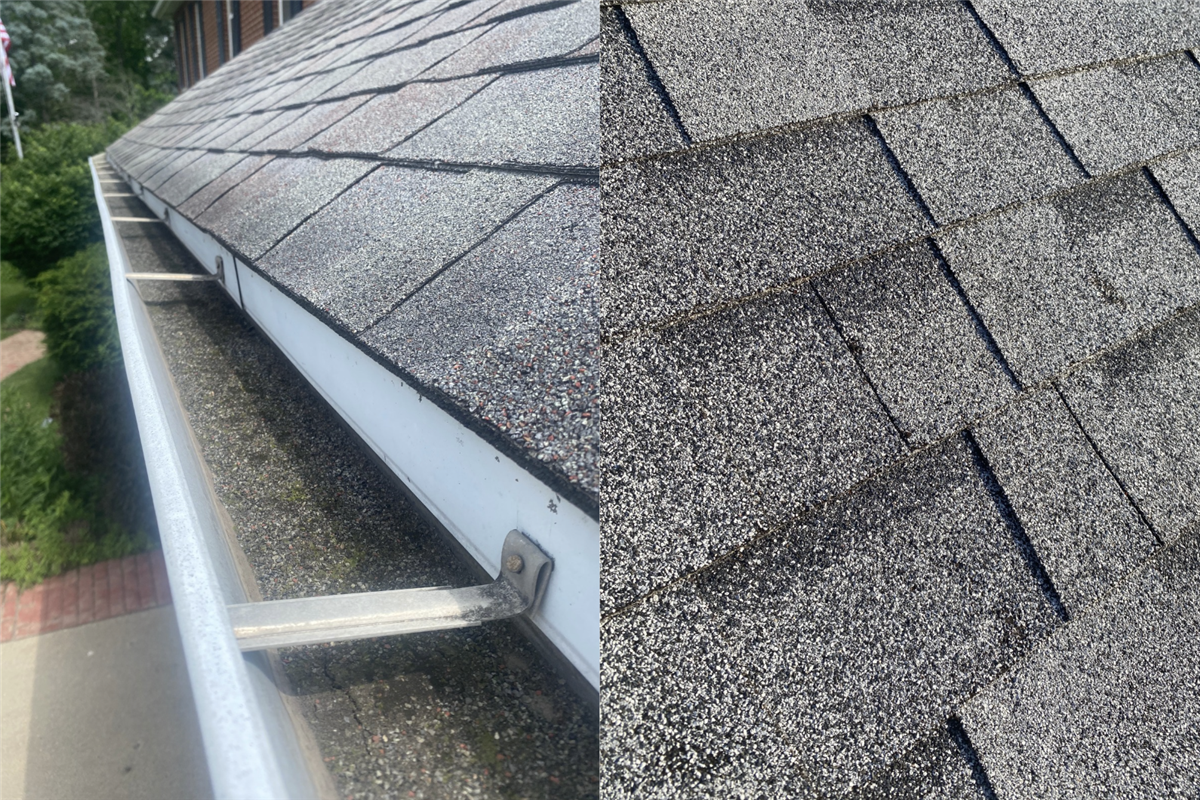
One Saturday afternoon, you're cleaning out the gutters and notice something that looks like coarse dark sand mixed in with the debris. Or maybe you spot what looks like a faded, discolored patch on your roof that you can't remember being there. Or maybe even a neighbor mentions they found a bunch of it around their downspout after the last storm.
Simply put, what you're looking at is granule loss and it's one, if not the most common roof concern we hear about from homeowners across Naperville and throughout Chicagoland - while also being one of the most misunderstood. Here is what's actually going on and how to know when it is something you need to take seriously.
What granules are and what they do
Asphalt shingles are not just a single layer of material. The surface you see is covered in small, coarse mineral granules(crushed rock, slate, or ceramic coated minerals) that are embedded into the asphalt beneath. Granules do several important jobs all at once.
Most critically, they protect the asphalt from UV radiation. Direct sun exposure degrades asphalt over time, making it dry, brittle, and prone to cracking. The granules act as a shield that slows that process down significantly. They also add fire resistance, give the shingle its color, and provide a layer of physical protection against impact and weather. When the granules are intact and evenly distributed, the shingle performs the way it is supposed to. When they start coming off, the asphalt underneath starts aging faster than it should.
Some granule loss is 100% normal
Before you panic, it is worth knowing that not all granule loss is a red flag. Brand new shingles typically shed some granules in the first few months after installation. This is excess material from the manufacturing process and it is completely normal. If you had a new roof put on in the last year or two and are seeing granules in your gutters, that is probably what you are looking at.
Light, gradual granule shedding over time is also part of how asphalt shingles age. A roof that is eight or ten years old is going to have lost some granules compared to day one and that is expected. What matters is the rate and the pattern of that granule loss, not just the presence of it.
When does granule loss become a real problem?
Here is where it gets important. There is a significant difference between normal gradual weathering and granule loss that is actively telling you something is wrong with your roof.
Firstly, the loss pattern matters more than the amount. Granule loss that is spread evenly across the whole roof surface is usually age related and can be assessed in the context of how old the roof is and how much life it has left. Granule loss that is concentrated in specific areas - particularly in circular or irregular patterns - is a different story. That pattern is the signature of hail impact. When hail strikes a shingle it knocks the granules off at the point of contact and leaves behind a soft spot or bruise in the asphalt beneath. From above those spots can look like color inconsistencies or bare patches. From your gutters they show up as a surge of granule debris after a storm.
The Fox Valley has had a rough stretch of storm activity this summer and hail impact granule loss is something our crews have been seeing on roofs across Naperville, Aurora, Batavia, and St. Charles throughout the season. If your home was in the path of any of this summer's storms, a professional inspection is worth scheduling sooner rather than later while the weather events are still fresh and documented.
The age of the roof is the other major factor. A fifteen year old roof showing accelerated granule loss in multiple areas is telling you it is approaching the end of its useful life. At that stage the asphalt underneath has already been through years of UV exposure and the granules holding on are doing less and less work. It does not mean you need a new roof today necessarily, but it does mean you want someone up there to give you an honest assessment of how much runway is left.
What exposed asphalt means for your roof
Once the granules come off of a section of a shingle, that section begins to age faster than the rest of the roof. UV radiation hits the bare asphalt directly, it dries out, starts to crack, and eventually loses the ability to shed water effectively. The shingle does not fail all at once - it deteriorates gradually in the affected areas until those areas are no longer waterproofing the roof beneath them.
This is why granule loss matters even when there is no active leak. The leak is what happens further down the road when granule loss is not addressed. A small area of compromised shingles during a normal rainstorm is fine. That same area during a heavy storm with wind driven rain is where water can find its way in.
What you can and cannot assess from the ground
Walking your property after a storm and looking up at the roofline can tell you some things. Obvious bare patches, significant color inconsistency across sections of your roof, or shingles that look visibly rough or deteriorated from below. These are all signs worth taking note of. Taking note of your gutters after a storm is also useful - a meaningful surge of granule material following a hail event would 100% be worth documenting.
What you cannot assess from the ground is the extent of the damage, whether specific granule loss patterns indicate storm damage versus normal aging, or whether the shingles have soft spots or bruising beneath the surface. That requires someone who knows what to look for getting up there and taking a look.
The same expertise that goes into installing a roof correctly is what makes a professional inspection really useful - a trained eye on your roof is going to find things that a walk around the yard simply cannot tell you, and that matters when you are trying to figure out whether you have a warranty claim, an insurance claim, or a roof that just needs monitoring.
Insurance
If the granule loss on your roof is hail related, it may be a covered insurance claim. Insurance covers sudden storm damage and concentrated granule loss from documented hail events qualifies as exactly that. The key is timing - most policies have reporting windows and the longer you wait after a qualifying event the more complicated the claim process can get.
If you had significant storm activity in your area recently and have not had your roof looked at, that is the most time-sensitive reason to get an inspection scheduled now rather than in the fall.
The bottom line
Some granule loss is normal. Concentrated or accelerating granule loss is not. The difference between the two is something an experienced roofer can tell you in a single inspection and that conversation is a lot less stressful than discovering a leak next spring.
If you are in Naperville, Aurora, Batavia, St. Charles, Geneva, or anywhere in Chicagoland and you have noticed granule loss on your roof or in your gutters, we are happy to come take a look and give you a straight read on what it means and what, if anything, needs to happen next.
📞 (630) 556-8099 | Schedule your free roof inspection at dwingconstruction.com →
Tags
Subscribe to D-Wing Windows, Siding & Roofing's Blog







Comments