What an Ice Dam Actually Is
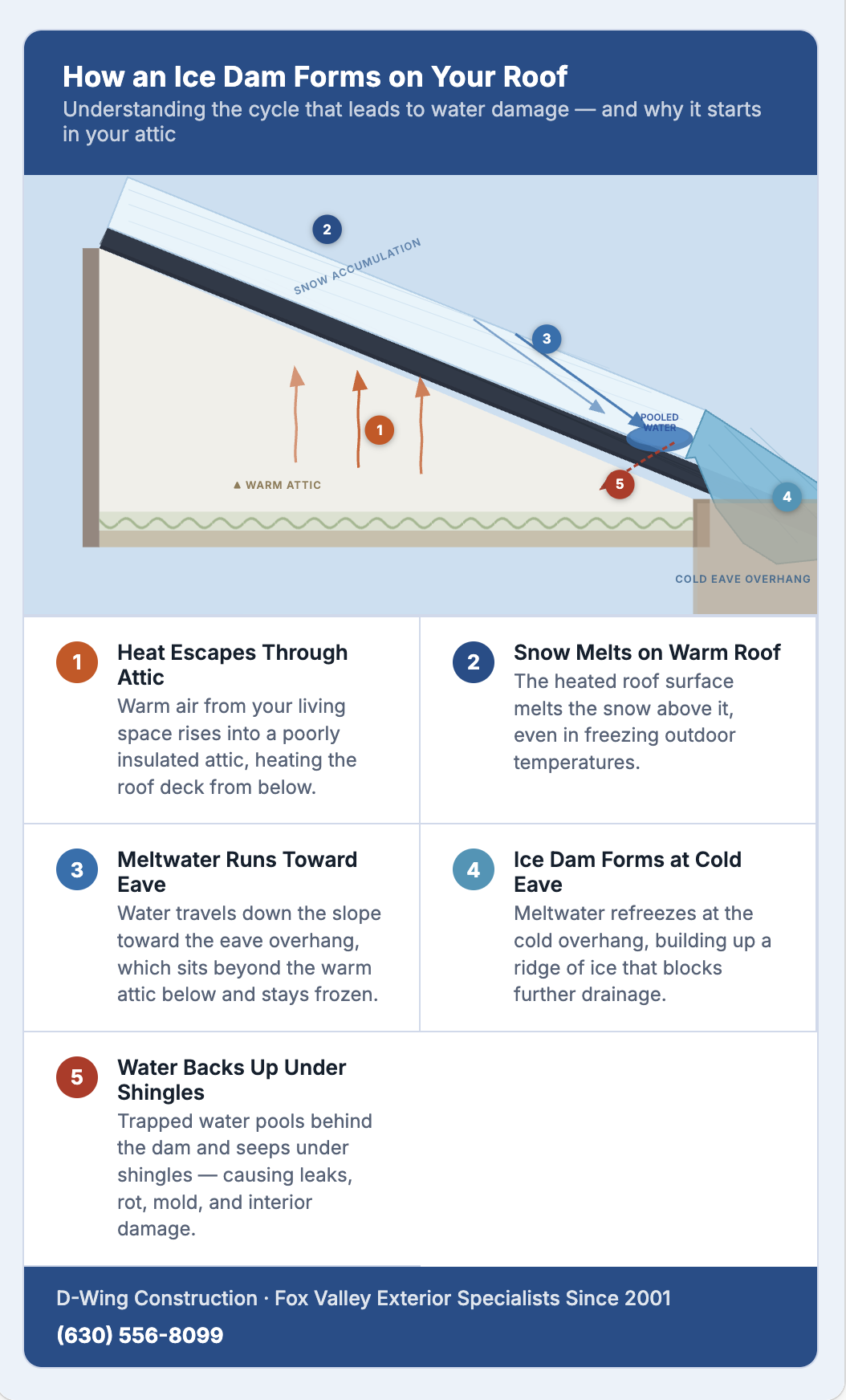
An ice dam is exactly what it sounds like: A ridge of ice that forms along the edge of your roof and blocks water from draining off. The water that builds up behind it has to go somewhere, and the path of least resistance is under your shingles.
Here's how it happens.
Your attic is warm, warmer than it should be, usually because of inadequate insulation or ventilation. That warmth heats the roof deck above it. The snow on the warm upper portion of your roof melts, even when it's 20 degrees outside. That meltwater runs down toward the flat edge of your roof called the eave. But the eave overhang sits over open air, not your warm attic. So it stays frozen. The meltwater hits that frozen zone and refreezes into a ridge of ice. More water follows. The ridge grows. The water behind it has nowhere to go but backwards and under your shingles.
Other Placements
The eave is the most common place - the majority of ice dam problems start there. But it's not the only spot to know about.
Roof valleys
A close second. A valley is where two slopes meet and channel water toward a single point. Snow collects heavily in valleys, and the flashing installed there is doing a lot of work. Flashing is the metal layer at transition points and seams where shingles alone can't make a complete seal. In normal conditions it redirects water away from those joints. In an ice dam situation, water is sitting still and under pressure, and any compromise in the flashing seal gives it a way in.
Skylights
Skylights can develop dams both above and below them, and because of where they sit on the slope they're often hard to see from the ground.
Roof penetrations
Pipe boots, exhaust vents, bathroom fans are all examples of spots where heat escapes from inside the house and creates localized melting right at the surface. That melt has to go somewhere, and if it hits a cold spot before it drains, you get a small dam forming around the penetration itself.
Rooms with vaulted ceilings
These can be a consistent problem because there's no attic buffer between the living space and the roof deck. The heat goes straight up. Bathrooms with vaulted ceilings are one of the most common offenders.
Ice Dams in Illinois in Particular
One of the more frustrating things with Illinois winters is their unpredictability. You'll have a week in the twenties, then a day or two in the upper thirties, then back down into the teens. The cycle of freeze, partial thaw, refreeze is what ice dams use to grow.
A roof in a place that stays consistently below freezing all winter doesn't develop ice dams as aggressively, because the meltwater never builds up significantly. But here in Chicagoland, we get the worst of both conditions. Cold enough to freeze everything, warm enough to melt the upper roof, cold again right where the water needs to drain.
The Damage
Water backed up behind an ice dam will find any imperfection in your roofing system and work its way through it. The most common damage we see is:
Water stains on ceilings and upper walls
This usually shows up directly below the eave line. If you're seeing brown stains or bubbling paint on an exterior-facing ceiling, an ice dam is high on the list of causes.
Wet or compressed attic insulation
Insulation that gets wet loses most of its effectiveness and can take weeks to dry out, if it dries out at all. Wet insulation is also at risk of mold.
Rotted roof decking and framing
Water that sits behind an ice dam long enough will saturate the wood decking below. That leads to rot, which means structural repairs may be needed.
Peeling paint and drywall damage
Water that gets past the roof deck eventually finds its way into the wall cavity and shows up as bubbled paint or soft drywall.
The Root Causes
Ice dams are a symptom of an attic problem, not a roof problem.
If your attic is properly insulated and ventilated, the roof surface stays close to the outdoor air temperature. Snow doesn't melt on the upper roof because the heat from inside never reaches the deck. No melt means no meltwater. No meltwater means no ice dam.
When attic insulation is thin, missing, or poorly installed, that heat escapes right into the roof deck. That's commonly what kicks off the whole cycle. Adding insulation and making sure your attic ventilation is working correctly is the long term fix.
What Ice and Water Shield Does
Even in a well-insulated home, ice dams can still form during extreme winters. That's where ice and water shield comes in.
Ice and water shield is a self-adhering membrane installed under the shingles along the eave and in valleys. It's designed to stop water from getting through even if it makes its way under the shingles. Building codes in Illinois require it along the eave overhang, but the minimum code requirement isn't always enough. A good installation extends it further up the slope and into any area prone to water pooling.
If your roof was installed without proper ice and water shield coverage, or if it's old enough that the adhesive has degraded, you're more vulnerable to the damage that comes with a bad ice dam winter.
What to Do / Not Do If You Suspect You have an Ice Dam(s)
WHAT TO DO / WHAT NOT TO DO
✅ DO:
- Call a professional who can safely remove ice from the roof without damaging shingles
- Have your attic insulation evaluated
- Document any interior damage for your insurance company
❌ DON'T:
- Chop at the ice dam with a pick axe or ice scraper. You'll damage the shingles and create more entry points for water
- Use rock salt or calcium chloride directly on shingles. This accelerates shingle degradation
- Ignore water stains on ceilings. The longer you wait, the more damage accumulates
- Assume the problem is solved once the ice melts in spring
The safest short-term measure is calcium chloride placed in a mesh sock or tube, laid perpendicular to the ice dam to create a channel for water to drain. A professional can do this without damaging the roof surface.
Long term? The real fix is addressing what's happening in the attic.
We've been helping homeowners deal with these problems for over 25 years. If you suspect anything on your home, please give us and call and we'll conduct a roof inspection free of charge.
📞 (630) 556-8099 | Schedule a free roof inspection at dwingconstruction.com/roofing/roof-inspections/
Tags
Subscribe to D-Wing Windows, Siding & Roofing's Blog







Comments