You notice a water stain on your ceiling.
You call a roofer. They get on the roof, come back down, and tell you it’s a flashing problem.
You nod like you understand.
You have no idea what they just said.
That's 100% a completely normal experience. Flashing is one of those parts of a roof that nobody either knows or thinks about. Here’s what it is, where it lives, and why it matters.
What Roof Flashing Is and What It Does
Flashing is thin metal sheeting installed anywhere on your roof where two surfaces meet or where something comes up through the roof. Its job is to seal those joints so water can’t get in.
Shingles cover the flat open areas of your roof well. But a roof isn’t just flat open areas. It has chimneys, pipes, walls, and creases where two slopes meet. At every one of those spots there’s a gap, and water is very good at finding gaps. Flashing covers them.
It doesn’t get much attention. But when it fails, you notice.
Where Flashing Lives on Your Roof
Chimney Flashing
Think of chimney flashing like a two-layer collar around the base of your chimney. The bottom layer wraps around the chimney where it meets the roof and slides under the shingles. The top layer overlaps it from above and is anchored into the chimney itself.
The two layers aren’t permanently joined. That’s intentional. Your chimney and your roof expand and contract at different rates as temperatures change, and if they were locked together something would crack. The overlap keeps water out while still allowing that natural movement.
Over time the sealant between them dries out, or the metal itself starts to corrode. When that happens water finds its way through and you end up with a leak that feels like it’s coming out of nowhere.
Valley Flashing
A valley is where two roof slopes meet and form a V-shape, like the crease in the middle of an open book. When it rains, water from both sides of the roof runs down and collects in that crease. More water moves through a valley than almost anywhere else on the roof.
Valley flashing runs along that crease and channels all of that water down and off the roof safely. Because it handles so much water it tends to wear faster than other areas.
Step Flashing
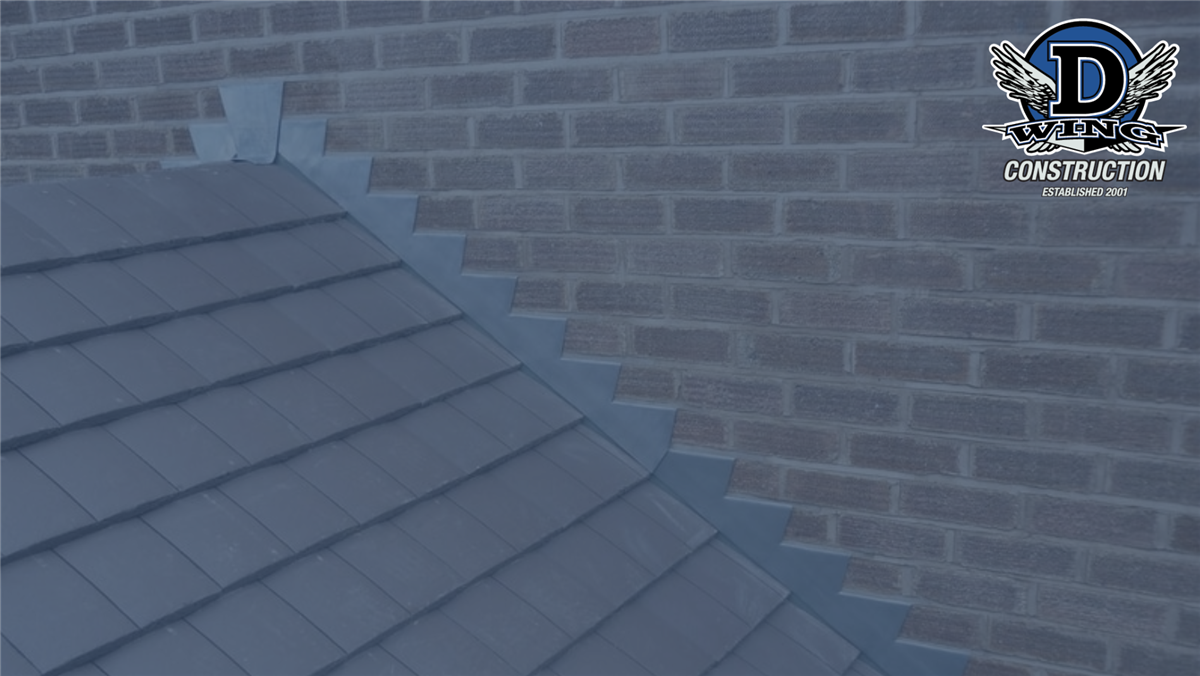
Step flashing is used anywhere a roof surface meets a vertical wall, like alongside a dormer or where a lower roof meets the side of the house. Instead of one long piece of metal, it uses a series of small L-shaped pieces that overlap each other going up the wall, each one tucked under the next row of shingles above it.
Picture how fish scales overlap. That’s the idea. Each piece directs water down onto the one below it and eventually off the roof. When it’s done right you get a continuous barrier. When it’s done wrong, water gets behind the wall.
Vent Pipe Flashing
Most homes have pipes that come up through the roof, usually for plumbing or appliance venting. Each one needs to be sealed where it breaks through the roof surface. Vent pipe flashing is a collar, usually rubber or metal, that fits snugly around the pipe and lies flat against the shingles around it.
The rubber version takes a beating from sun and temperature changes over the years and eventually starts to crack or pull away from the pipe. On an older roof this is often where a leak quietly starts, even when the shingles look perfectly fine from the ground.
Drip Edge
Drip edge is a strip of metal that runs along the very edges of your roof, both the bottom edge and the two side edges. Its job is to make sure water leaving the roof flows cleanly into the gutters rather than sneaking back underneath the shingles at the edge or running down the wood trim below.
It’s a simple piece but without it water can work its way under the shingles at the edges over time and start rotting the wood underneath.
A Quick Visual Reference
Flashing Type | Location | What It Seals |
|---|---|---|
Chimney flashing | Around the base of the chimney | Joint between chimney and roof |
Valley flashing | Where two roof slopes meet | The V-shaped crease between slopes |
Step flashing | Where roof meets a vertical wall | Transition along walls and dormers |
Vent pipe flashing | Around pipes coming through the roof | Penetrations through the roof surface |
Drip edge | Along the roof’s outer edges | Bottom and side edges of the roof |
Why Flashing Fails
Flashing is metal and metal doesn’t last forever. Here are the most common reasons it fails:
- The metal corrodes over time, especially on older roofs
- Temperature swings through Illinois winters and summers gradually work it loose year after year
- The sealant and caulk around it dries out and cracks
- Ice in winter forces its way under areas that held up fine in warmer weather
- Poor installation shortcuts that were invisible from the ground from day one
And if it wasn’t installed carefully to begin with, it fails faster. Small shortcuts during installation, the kind you’d never see from the ground, are often what cause a roof to start leaking years before it should.
The quality of the installation is what separates a flashing job that lasts 20 years from one that starts causing problems in five. It’s one of the things we look at closely on every job we do.
What a Flashing Problem Looks Like From Inside Your House
You usually don’t see the failed flashing. You see what it let in.
A water stain on the ceiling near a chimney is one of the most common signs. A leak that only shows up during certain storms, especially when rain is coming in sideways, is often a valley or step flashing issue. If you notice a damp smell or discoloration near any of the pipes that come through your roof, that’s usually the rubber collar breaking down. And damage along the very edges of your ceiling near the outer walls often points to a drip edge problem.
Flashing problems rarely announce themselves immediately. A small failure lets in a small amount of water. That water travels along rafters and soaks into insulation long before it ever shows up as a visible stain. By the time you see it inside the house, the problem has usually been there a while.
Getting a professional inspection done before winter is one of the best things you can do for a roof that’s been through a year like 2026, and flashing is always on the checklist.
We inspect flashing on every roof we get on across Aurora, Naperville, Batavia, St. Charles, Geneva, and the Fox Valley. It’s one of the first places we look because it’s one of the first places problems start. If you haven’t had your roof looked at recently, give us a call.
📞 (630) 556-8099 | Schedule your free roof inspection at dwingconstruction.com →
Tags
Subscribe to D-Wing Windows, Siding & Roofing's Blog





Comments